
Bus rapid transit will make Edmonton’s most use bus corridors faster and more reliable, and connect more of our city to mass transit.
70% of transit trips in Edmonton take place on a bus, but many of our most popular routes see constant delays, suffer from slow speeds, and leave riders packed together.
Edmonton’s three busiest bus routes (the 4, 8, and 9) are responsible for 40,000 transit trips every single weekday, but show up late nearly one third of all trips, derailing people’s plans and eroding their trust in our transit system. This has to change.
Right now, Edmonton is planning a bus rapid transit (BRT) network to make our busiest transit corridors like Whyte Avenue and 97/101 streets faster, more reliable, and more comfortable.
We think City Council should take this project across the finish line NOW!
The most impactful thing that you can do to help make buses better is reach out to your councillor and tell them that you want this project funded ASAP. We can’t have Council only hearing anti-transit voices, even if these routes don’t directly help you, tens of thousands of Edmontonians who deserve reliable transit to get to work, school, and community will benefit from this investment.
Read below for more information on what bus rapid transit is and why Edmonton needs it.
What will Bus Rapid Transit Look Like?
What is BRT?
Edmonton describes bus rapid transit as having “a similar level of service to light rail transit by giving the buses their own dedicated lanes for at least 75% of the route and priority at intersections. These routes will be served by stations and enhanced stops.” While meeting many of the definitions of bus rapid transit outlined above, the lack of dedicated lanes for up to 25% of the routes pose some risk that future bus rapid transit lines will not improve transit reliability and speed as much as they should.
Where will it go?
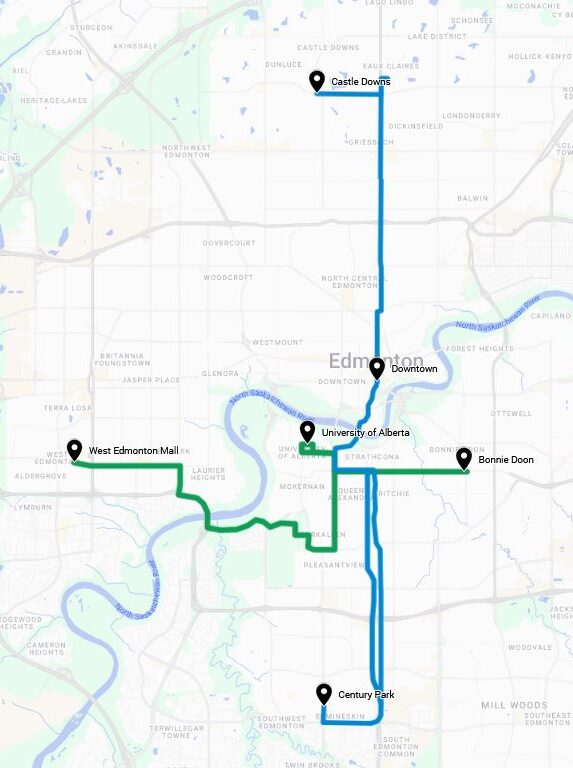
The 2 major BRT routes being planned improve Edmonton’s busiest transit corridors, and extend service into underserved parts of our city.
The B1 Route (left) runs north-south through central Edmonton, connecting Castle Downs and Century Park, mostly along 97th street, 101st street, Calgary Trail, and Gateway Boulevard. This route will connect major destinations like Eaux Claires, Northgate Mall, Chinatown, Downtown, Old Strathcona, and Calgary Trail, as well as two LRT stations and four transit centres. This route fills in a massive gap in transit service to the major commercial street of Calgary Trail, which currently is only served by a low-frequency circulator bus connecting into Southgate. North of the river, this route covers the Northside’s main connection to Downtown, with 23,000 trips between the Northside and central Edmonton daily.
The B2 Route (right) runs east-west to the south of Edmonton’s core, connecting West Edmonton Mall to Bonnie Doon, mostly along Whitemud Freeway, Fox Drive, 109th Street, and Whyte Avenue. This route will connect major destinations like the University of Alberta’s North campus and Old Strathcona, as well as at least four LRT stations and three transit centres. This route could improve travel times along the constantly traffic-filled Whyte Avenue, and be a key connection to Edmonton’s west end. Currently routes between West Edmonton Mall and south-central Edmonton see 16,000 rides a day, while Whyte Avenue between the University of Alberta and Bonnie Doon sees 7,000 boardings everyday (not counting trips that travel through the avenue)
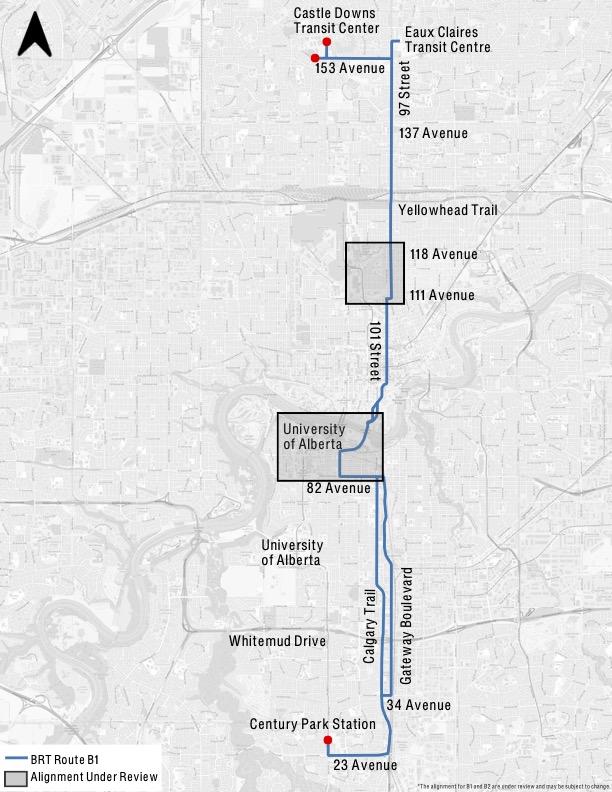
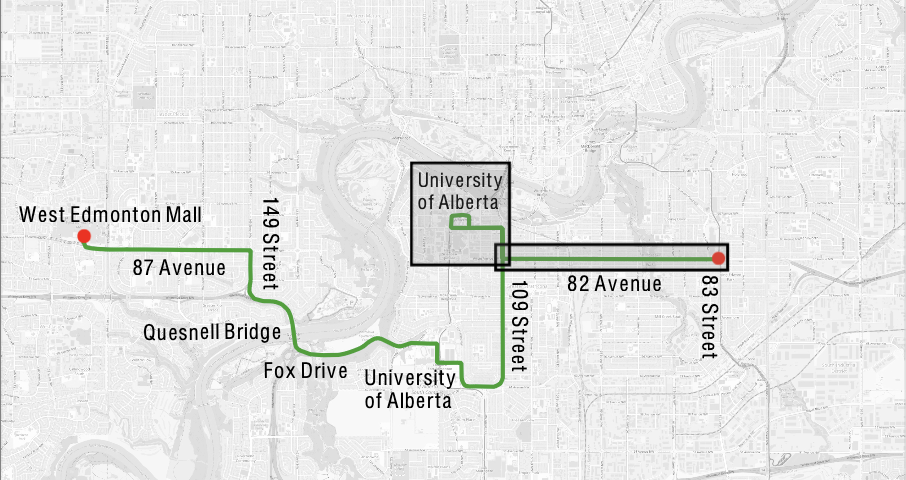
Images from the City of Edmonton
Both of these corridors already have high transit ridership. The improved speed, reliability, and comfort that could come with bus rapid transit will attract many more riders, and unlock more corners of our city to those who don’t want to sit in traffic all day.
What are the next steps?
In the 2023-2026 budget, City Council funded concept planning for both of these routes. This includes what roads the BRT will run along, where transit lanes will be placed, and where stations will be located. This is the phase where the public can have the most influence over the project, and is where we need to make sure that the infrastructure adequately prioritizes transit.
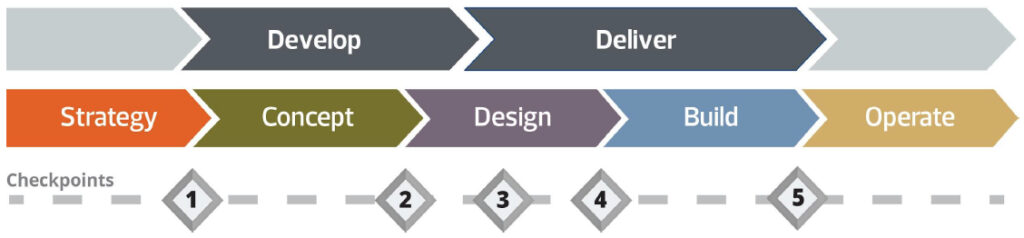
Bus rapid transit is effective because it can be implemented quickly and affordably. There is no sense in leaving these plans on a shelf for a decade like other Canadian cities have done, letting our main arteries further clog with traffic while transit riders on our busiest routes are still waiting on cracked sidewalks for a bus that is 15 minutes late. With the 2027-2030 budget discussions planned for late 2026, it is time for Council to fund detailed design and construction of BOTH BRT routes, and show that Edmonton can be a leader in both public transit and effective planning.
Why do we need Bus Rapid Transit?
Nearly every transit rider in Edmonton has stood in a cramped bus with 50 other people as it crawls down Whyte Ave or 101st street, barely moving a block every light cycle, as drivers sitting alone in their massive cars clog the streets ahead, and nearly every transit rider has stood in -30 degree weather waiting for their bus that was supposed to show up 20 minutes ago. Everybody should have access to our city, but right now, even with transit ridership at an all-time high, our transportation system prioritizes the least space efficient and least affordable mode of transportation. We need a fast and reliable public transit network, and these bus rapid transit routes will help achieve that goal along our busiest and most-delayed routes.
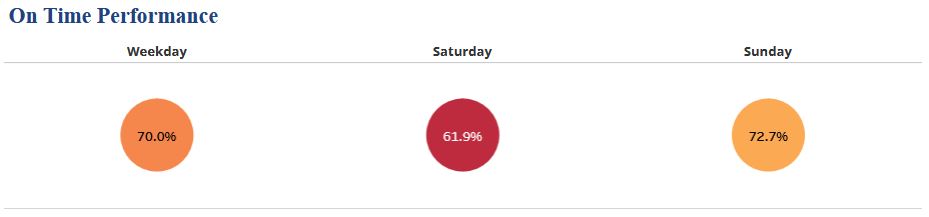
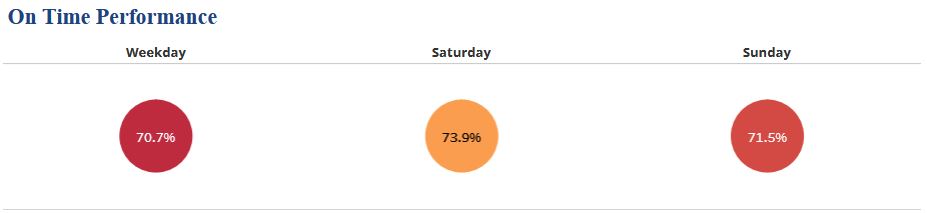
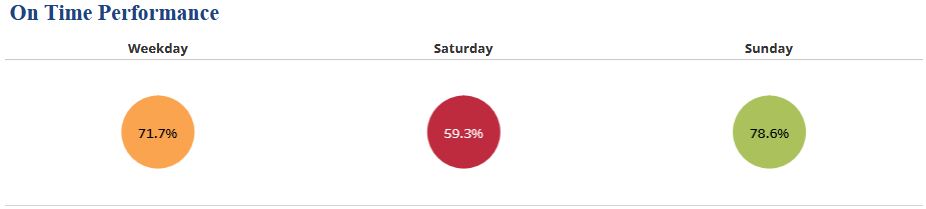
Images from ETS Route Report Cards for Fall 2024. Route 4 (top left), Route 8 (top right), and Route 9 (bottom left)
With 150,000 more Edmontonians today compared to 2020 and with population growth likely to continue, we need to avoid the gridlock that cities like Vancouver and Toronto face. Sacrificing rows of homes and businesses to build more clogged car-lanes is not a viable solution, densifying our transportation system through improvements to public transit is the only option.
Building these routes now is a fiscally responsible, common-sense solution for our transportation system that we could see operational in just a few years.
How do we get Bus Rapid Transit Built?
While the need for these routes is clear, there is a lot standing in the way. We need to make sure that city administration doesn’t water down what should be rapid transit routes with high-levels of priority, especially at the most congested intersections. We also need to make sure that council doesn’t get scared by the drivers mad at losing the street parking in front of their parking lots, or two of their seven car lanes.
How do we do that?
- Send an email (link above) to Council and administration telling them how faster and more reliable buses will improve your life,
- Show up to engagement sessions and fill out surveys released by the city, and
- Spread the word about how good this network *could* be, if we get it right (seriously, embrace being the annoying transit-lover in the friend group);

Image from the Old Strathcona Public Realms Strategy