
Every year, City Operations branches report on each branch’s key results, service objectives and performance measures, documenting the past year’s initiatives and successes, as well as forecasting programs, growth, and needs for the next year.
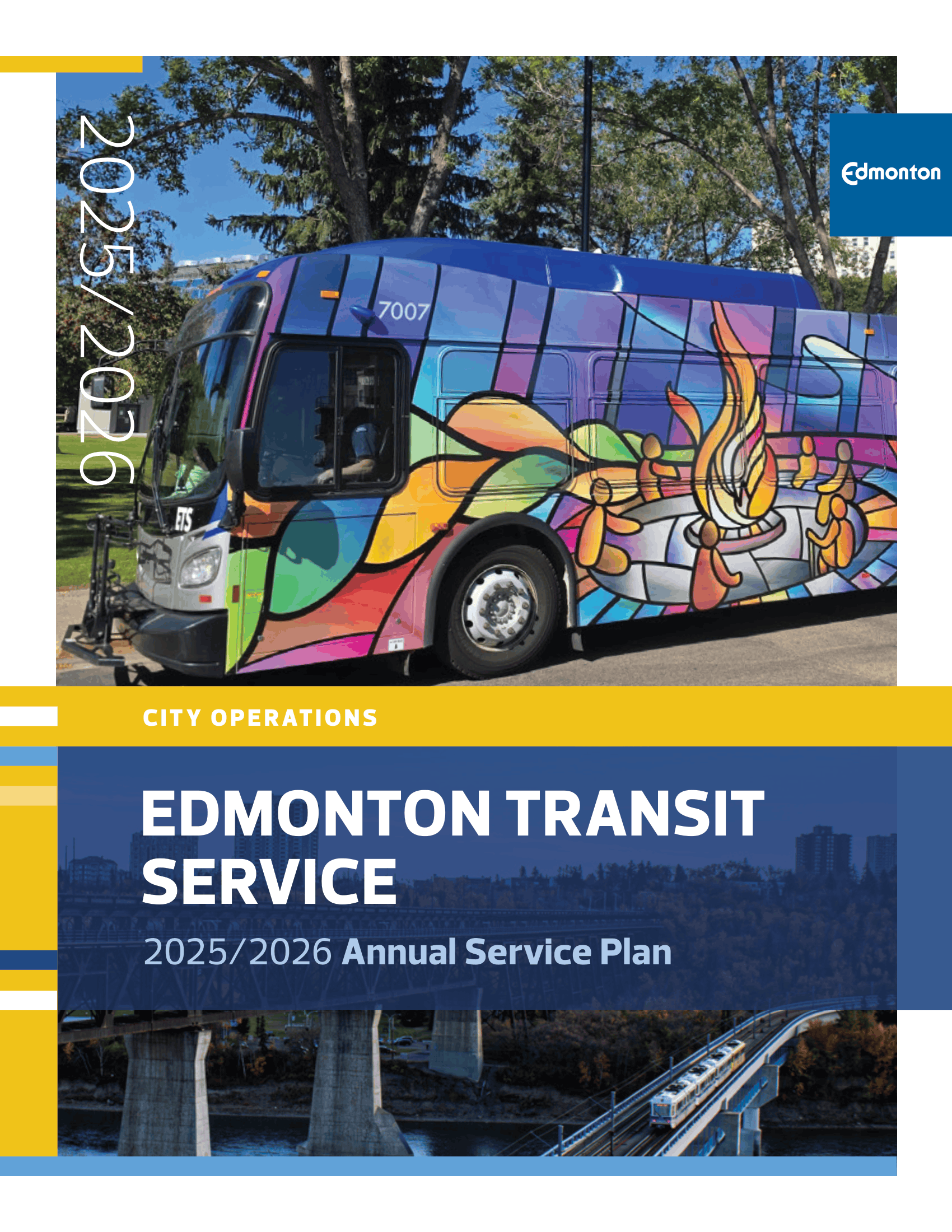
Edmonton Transit Service’s 2025-2026 Annual Service Plan (ASP) is a much anticipated overview of ETS’ upcoming goals, priorities, and potential challenges that help to inform ETR’s advocacy. Last year, the ASP came with plenty of good news, including an increase in bus service hours and a conversion of On Demand routes to conventional service.
Although we got to look back on the success of these new service hours and routes, we are faced with a stark reality for the upcoming years: we are out of service hours to add. We are out of vehicles for peak hour service. We need coordinated support from City Council in the upcoming budget cycle to introduce improvements to transit service – or we will be largely stalled out until 2031.
The Good: Convenience and Accessibility for All Riders
ETS continues to look for ways to make transit more convenient, accessible, and inclusive. The recent launch of Arc Tap to Pay allows riders to use cards or digital wallets on Arc readers. This is especially useful for people who only take transit occasionally, like for specific events, or are taking transit for the first time, like those visiting Edmonton. They are also useful for me, when I forget my Arc card in my other pants and need to pay my bus fare. The Ticket To Ride program also introduces convenience for event oriented riders, with tickets for Commonwealth Stadium events now including a valid transit fare. These are the kinds of upgrades to a transit system that draw people to be able to use it for the first time, seeing what transit has to offer to get them to destinations effectively and efficiently. Even if individuals don’t want to ditch their cars full time, supporting a more efficient use of space around the busiest parts of the city is a key part of achieving vibrancy and efficiency goals.
Additionally, ETS’ partnership with the Canadian National Institute for the Blind (CNIB) made some physical improvements to assist riders with disabilities, as well as led to the Get On Board campaign to highlight potentially hard to see disabilities in transit spaces.
We certainly can’t scoff at the additions made to reliability and efficiency in 2025, either. Between the implementation of Transit Priority Measures, the confirmed funding for 25 conventional buses, and the addition of 1,400 weekly bus service hours made in April 2025, on-time performance rose, now to an overall of 83% on-time performance. Plus, a vendor was selected for the procurement of the replacement high floor light rail vehicles (LRVs).
Want to celebrate more wins with us? Check out ETR and ETS’ Annual Service Plan Awards on April 26th!
In the upcoming year, riders can look forward to more improvements including the addition of cellular service in LRT tunnels. This means you can still check the real time data on that bus you need to catch, even in the downtown tunnels. Other exciting infrastructure improvements include the integrated control centre that was advanced in the Fall Budget Adjustment, the funding of automated passenger counters (APCs) on high-floor LRT cars, and updated bike racks to better accommodate a wider range of modern bikes. Plus, we are due to see the formal renaming of Government Centre Station.
The Bad: One Step Forward, Then Wait Two Years
Remember those Transit Priority Measures that were rolled out? Some have already been rolled back – at the March 23rd Urban Planning Committee meeting, a motion passed to revert the 101 St bus lane to peak hours only and allowing parking in the dedicated lane during off peak hours. Those buses ordered? They will not be ready for service until 2027 – and they will mean that ETS garages are completely at capacity and zero new buses or service will be able to be added until the opening of the Southeast Transit Garage in six years. The replacement trains? Not until 2028 at the earliest. Which leads us to…
The Ugly: Without Investment, Service is Stalled Out
After the delivery of the 25 buses on order and until we get more storage space for buses, our peak service is completely levelled off. This means any attempts to alleviate overcrowding, improve frequency or reliability, or expand service will directly result in cuts to other areas during these times. This could very well lead to areas being transferred from conventional service to On Demand, or being left with gaps in service altogether. While the opening of Valley Line West and Capital Line South, slated for 2028, will allow for some bus service hours to be redistributed, this will not happen until 2028/2029.
Even during off peak hours when buses may be available for use, we will not be seeing additional service hours added in 2026. This means, again, all service hour additions in the immediate future are the result of a cut somewhere else. This optimization and shifting is a natural part of transit service planning, but even the identification of 25 school trips for reduction or consolidation (removing service from students) will lead to only 100 hours per week to reallocate. This means additional service must be put on the chopping block as well – including Owl Service (until 3AM) being placed up for review. While the ASP notes that ridership has been lower than expected on Sunday-Thursday nights, removing all service options at these late-night times would be disastrous for accessibility and reliability.
In addition to the bus service, Capital and Metro Line LRT service are now operating at maximum fleet book out capacity from Monday to Thursday during peak hours. No alleviation from overcrowding, no more frequency on the Metro Line until the replacement LRVs start flowing in.
We know that our service is doomed to suffer if not given the appropriate operational funding and capital considerations. Heading into budget discussions in the fall, Edmonton Transit Riders are doing everything possible to make sure the voices of transit users across the city are heard and considered in deliberations. We are doing our best to ensure every item gets advanced for consideration in the budget, including:
- Exploring options to expand the bus fleet before the completion of the Southeast Garage,
- Advancing Transit Priority Measures to increase reliability and efficiency,
- Forwarding the Bus Rapid Transit plan,
- Maintaining the current transit fare structure and reduced fare options,
- Prioritizing service increases in underserved areas,
Though it is likely that sacrifices will have to be made in the budgeting process, it is crucial that Council hear from real Edmontonians and real transit riders what is most important to them. By speaking at committee meetings and participating in engagement events online and across the city, we can ensure that the needs and priorities of individuals who rely on effective, efficient, and accessible transit are given the attention they deserve.